Wednesday, June 11, 2014

The Amazing Adventure of Relationships: a musical ethnodrama by The Centre for the Arts in Human Development at Concordia University

www.inspirationsnews.com
www.facebook.com/inspirationsnews
www.twitter.com/inspirationsmtl

The Centre for the Arts in Human Development at Concordia University presents:
The Amazing Adventure of Relationships:
a musical ethnodrama


June 12, 13 & 14, 2014

The Centre for the Arts in Human Development at Concordia University (CAHD), established in 1996, is an educational, clinical and research centre serving adults with developmental disabilities and other special needs populations. Located at the university's Loyola Campus in Montreal, Quebec, the Centre is under the auspices of the Department of Creative Arts Therapies in the Faculty of Fine Arts.

Under the direction of Dr. Stephen Snow, every second year CAHD presents a musical ethnodrama. As Dr. Snow describes, "an ethnodrama is a research play because it asks questions. The audience becomes co-researchers as they watch the show. The play is the research report." Actor Amanda explained how the six month process of creating the ethnodrama worked: "We dealt with the issues with perseverance. We didn't give up. We were taught to give 100 percent. And that's what we did."

I had the honour of attending the preview of this show this morning. Produced by Lenore Vosberg, The Amazing Adventures of Relationships is played by 17 actors, who, with enormous courage, share their innermost thoughts and experiences about relationships. It is honest, endearing, and thoughtful. It is not often that we are given the gift of exploration. And this group was fortunate enough to work together to ask, and answer their questions about relationships, intimacy and love.
The show is broken down into three parts.


In the first part, the actors explore issues that include the importance of family, friends, pets, conflict, love, being hurt. All the nitty gritty ins and outs of relationships. Intertwined with catchy and moving musical numbers, the honesty was touching, and I'm certain, due to their reaction, that everyone in the audience (myself included) could relate the material to their own life experiences. 
The second part brings us right into a sex education class where lessons about sexuality, that are often kept hidden, are openly discussed, cleverly including the audience in the 'class'. This bold experiment worked extremely well, opening up an important discussion, particularly about safe sexual health. In addition, by using a baseball analogy, they cleverly demonstrate the participants varying views on intimacy, sexuality, love and relationships.
The third part was most touching to me, where each actor shared their dreams for the future. I won't share those with you, I think you will see what I mean when you see the show. It will make you think hard about your own future dreams.
The ethnodrama concludes with a talk back with the actors. Audience members loved the show, and had a lot to share. 

This ethnodrama is bold, provocative, powerful, emotional, serous and seriously funny. Be prepared to laugh and cry, and share the lessons you will learn! Congratulations to all involved. And thank you.
The show runs from June 12 to 14 at 7:30 p.m. at St. Ignatius of Loyola Church, 4455 West Broadway. 
Unique in Canada, CAHD uses four types of creative arts therapies – art, drama, music and dance/movement – to promote autonomy, improve self-confidence and social skills, and enhance overall quality of life for its participants.
The Centre's mandate is fourfold: providing a setting for therapeutic programs in the creative arts therapies, facilitating student education and training, fostering research, and educating the public, by creating awareness of the abilities of persons with special needs.


Wednesday, April 23, 2014

Le Défi Sportif Altergo is about to begin!

www.inspirationsnews.com
www.facebook.com/inspirationsnews
www.twitter.com/inspirationsmtl

Le Défi Sportif Altergo - April 28 - May 4

World unique, Le Défi Sportif Altergo is an international event that gathers athletes from elite to newcomers, with all types of disabilities. From April 28 to May 4, about 4,600 athletes from approximately 15 countries compete in Montreal, Longueuil and Boucherville. This event values the success of athletes with disabilities and contributes to spreading the notion of universal accessibility.

In honour of this event, we are spotlighting two elite Quebec athletes - Marco Dispaltro, and 'Capitaine' Bruno Haché. We think you'll enjoy reading their profiles.

Check out the Défi Sportif website at www.defisportif.com for the schedule of events. It's an amazing experience, so try to get their to cheer these awesome athletes on! And follow their news on Facebook: https://www.facebook.com/Defisportif. Profiles provided courtesy of Défi Sportif Altergo.

Marco Dispaltro: on his way to the top

He has practised wheelchair rugby and tennis at the highest levels. Marco Dispaltro has been practising boccia for four years now and is vying for the title of best player in his category in the world, nothing less.

Presently second in world rankings in the BC4[1] category, the London Paralympics bronze medalist in doubles is on his way to the top. And he hopes the points he accumulates at the Défi sportif AlterGo will propel him to the first rank.


A Canadian first: a World Open Boccia event

This is the first year that the Défi's international boccia tournament will be sanctioned by the Boccia International Sports Federation (BisFed) and that the points will go towards world rankings. Athletes from Brazil, Russia and even Australia will be coming to Montreal.

Should he finish among the first six contenders, Dispaltro could overtake the number one, Chinese athlete Yuansen Zheng. The Saint-Jérôme athlete knows only too well  he will face stiff competition. " The Brazilians are very strong and they will do their best to stop me from becoming number one".

 "2014 is a big year for me", says Dispaltro. He will be participating in his first World boccia championships next fall. He is ready: "I have worked on some technical details and mastered even more difficult throws. I function well under pressure so the table is set", he acknowledges.
 
Photo credit (Marco Dispaltro) : Associação Nacional de Desporto para Deficientes / ANDE
New recruits and elite coming together at the Défi sportif AlterGo

Although he has only been practising boccia for four years, Marco Dispaltro has been following the evolution of the sport at the Défi sportif AlterGo. "At the international level, the number of athletes has been growing year over year. I especially like to see the level of interest at the school level. They are the future of our sport and I understand how important it is to them to rub shoulders with the elite. It is inspiring for them, but also for us. I am touched by their sense of wonder", adds Dispaltro, who is very involved in different aspects of initiation to the sport.

The sport has also gained in popularity on the world scene. "People are taking us more seriously. There has been a vast improvement in the depth of the teams. Boccia is in full swing and it is probably one of the fastest growing paralympic sports in the world", he observes.

Suffering from muscular dystrophy, Marco Dispaltro knows that only sport can slow down the progress of the disease. "Sport has changed my life. Were it not for sport, I would probably be in a power chair and have difficulty moving", he insists.

At age 46 , he hopes to enjoy a long career. When he can no longer throw, he knows he will be able to use ramps and is already working on customized designs. "Some people pity me when they see my condition deteriorating. I see it as an opportunity to practise new sports", he concludes.

[1] This division is for players with a severe locomotor dysfunction on all four limbs and little dynamic control of the trunk. These players can't be assisted although they can ask for help from the referee to pick up a ball or to get on the court, for example. Source : Association québécoise de sports pour paralytiques cérébraux.


Capitaine Bruno

Dès sa nomination de capitaine de l’équipe nationale de goalball, l’été dernier, Bruno Haché a conduit ses coéquipiers vers la médaille d’or aux Championnats panaméricains. « C’est le point marquant de ma carrière jusqu’à maintenant », admet l’athlète de 36 ans, qui a pris la relève de son mentor, Mario Caron, maintenant à la retraite après sept participations aux Jeux paralympiques.

« Jouer à ses côtés a toujours été intimidant, mais évoluer auprès de lui a aussi été une fierté. J’ai beaucoup appris sur les tactiques offensives et défensives grâce à lui. Il nous laisse un grand héritage. »

Le talent de Bruno traverse même les frontières. Il l’a appris à son insu  lors d’un tournoi au Michigan, l’hiver dernier. « Les Américains parlaient de mes lancers, de ma puissance et de la difficulté de jouer contre moi. C’est une fierté pour moi de voir mes qualités de joueur reconnues à l’extérieur du pays. Cela démontre aussi que je continue à progresser », se réjouit-il.

Un coup de pouce du Défi sportif AlterGo
Son intégration au sein de l’équipe nationale, Bruno Haché le doit un peu au Défi sportif AlterGo. Deux ans après ses débuts, c’est un camp d’entraînement qui l’amène à y participer en 2003. Bruno impressionne les dirigeants de la formation canadienne et obtient sa place, ce qui le mènera partout sur la planète.
Photo credit (Marco Dispaltro) : Associação Nacional de Desporto para Deficientes / ANDE

Trois Jeux paralympiques plus tard, le Montréalais a toujours rendez-vous avec le Défi sportif AlterGo. Mais ce n’est plus à titre de joueur. Il reste sur les lignes de côté et côtoie la relève. « Je suis sur place pour parler avec les athlètes et leur partager mon expérience au sein de l’équipe nationale. »

Cette année, Bruno Haché sera particulièrement attentif aux séances d’échauffement des équipes participantes. Une initiative de la fédération provinciale et de son préparateur physique le met en vedette dans une vidéo qui reproduit une séance d’activation d’avant-match. Cette vidéo a été distribuée à travers la province. « Il y a trois niveaux et c’est spécifique au goalball pour éviter les blessures », explique celui qui espère reconnaître l’application de certains procédés. Pour Bruno, c’est une autre façon de partager son expérience. « Je trouve ça important d’aider la relève. Lorsque c’était moi qui débutais, j’ai eu cette chance. C’est à mon tour de redonner. »

L’histoire d’un sportif
Actuellement ouvrier de maintenance à l'Institut Nazareth et Louis Braille, Bruno Haché a commencé à perdre la vue à l’âge de 18 ans en raison de sa condition génétique. « J’ai peu de vision centrale ». L’année suivant son diagnostic, le Québécois n’en mène pas large. C’est grâce au hockey sonore qu’il renoue avec le sport. « L’entraîneur de l’équipe de goalball jouait aussi et m’avait remarqué, même si après un an d’inactivité, je n’étais pas en super forme. Il a réalisé que j’évoluais rapidement et m’a invité à essayer le goalball. »

« Au premier entraînement, j’étais vidé après l’échauffement. Mais ça m’a donné le goût de me mettre en forme et d’évoluer. Ça m’a aussi redonné confiance. »

Bruno Haché n’a pas fait une croix sur le hockey sonore et a récemment recommencé à chausser ses patins. Puisque le sport se développe, il ne dirait pas non à un changement de cap. « Reste à savoir si la discipline sera au programme des Jeux paralympiques de 2022! » conclut-il.

Check out our Inspirations EXPRESS for more information about the Défi!
http://www.inspirationsnews.com/pdf_en/OnlineEditions/Inspirations_Express-2014-april.pdf


Monday, March 31, 2014

Montreal Autism in Motion Conference and Exhibit: Forward thinkers advance autism


www.inspirationsnews.com
www.facebook.com/inspirationsnews
www.twitter.com/inspirationsmtl


Montreal Autism in Motion Conference and Exhibit: 
Forward thinkers advance autism

It was an uplifting weekend for the over 200 people that attended the Montreal Autism in Motion Conference and Exhibit on March 30, 2014 at the Crowne Plaza Montreal Airport.

Organizers Andre Pereira and Tracy Pennimpede, in conjunction with Giant Steps School, handpicked a list of speakers that shone an encouraging light on autism; shifting from what conference presenter Dr. Stephen Shore described as “the closed door of ‘disability’ and ‘disorder’” to a mindset that leads to lifelong success.


 Andre Pereira, Tracy Pennimpede, Nick Katalifos, and Nick Primiano (Director of Giant Steps School)

The day began with a keynote address from Nick Katalifos, Chairman of the Giant Steps School and Resource Centre, who shared his family’s journey from the moment their son was diagnosed with autism, and the role that the schools play in their community. Katalifos’ story resonated with many, particularly when he shared his closing remarks, “We’ve got a long way to go, but we are very proud of how far he’s come.”

Presenters included medical professional Dr. Laurent Mottron, Soma Mukhopadhyay, who Skyped in to discuss the methodology of the Soma Rapid Prompting Method, and Lucila Guerrero, an artist who has Asperger's Syndrome.

Presenter Dr. Stephen Shore was diagnosed with “Atypical Development and strong autistic tendencies,” and deemed “too sick” for outpatient treatment. He was non-verbal until he was four years old. With much support, he is now a professor at Adelphi University where his research focuses on matching best practice to the needs of people with autism.

There is no one better to explain autism than someone who has it. “Before any teaching begins you have to create a trusted relationship with the learner,” said Dr. Shore, whose anecdotes of bathroom etiquette engaged his audience in a lively discussion about the trickiness of rules. “We spend so much time telling people the rules and that they aren’t doing things right. We need to show them what they are doing right so we can increase their self-esteem."

Specialisterne Canada sees integrating people on the autism spectrum into the Canadian workforce as a series of opportunities rather than problems to overcome. This 10-year-old company that began in Denmark finds jobs that people with autism can succeed at, and creates an environment within businesses in which they can be productive. They eliminate the traditional interview process that proves to be so difficult for people with an ASD. “We focus on talent and what people can do,” says Alan Kriss, CEO of Specialisterne Canada during his presentation. "We go to businesses and inform early adapters of the opportunity before them in hiring people with an ASD."


Kristine Barnett, author and mother of 14-year-old Jacob, who has an IQ higher than Einstein, addressed a crowd that included many who had read her book The Spark: A Mother’s Story of Nurturing Genius. Barnett also discussed ‘rules’…a recurring theme over the course of the conference.. and how beneficial it can be to break them.

Nobody knew Jacob had autism when the book was published because of Barnett’s awareness of the power of labels. “First thing you get is ‘can’t”, she shared.

Jacob developed an original theory in Physics when he was 12 years old. “They said that he should learn social skills in hopes of avoiding an institution. Guess what? He is in an institution now – The Perimeter Institute for Theoretical Physics in Waterloo, Ontario,” says Barnett.

Barnett shares a potent message on the power of unearthing the hidden abilities in all children with an ASD: “Look for their special skills and talents. Ask them what they want to do. It is important to let them tell you what they want. It’s time to see kids with autism in the way we finally should be looking at them.”

45 exhibitors enjoyed sharing their services with the public in a lively, open space.

 Mi & Stu and their delicious gluten-free treats

On March 30th, Montreal Autism in Motion, in conjunction with Giant Steps School, hosted a Roundtable on Advancing with Autism that brought over 30 stakeholders, including government, service providers and parents, together to exchange ideas and collaborate on future projects to benefit the community at large. The agenda included creating an Autism-Friendly city, education and employment, and housing and respite.

It was an engaging weekend that brought much needed light to the future of autism, on the eve of Autism Awareness Month.


Posted by Wendy Singer, Managing Editor, Inspirations Newspaper
info@inspirationsnews.com
www.inspirationsnews.com


Check out the news in the inaugural edition of the
Inspirations Express!

Featuring a full page of Autism Awareness Month activities


Wednesday, March 12, 2014

'Deaf Snow White' combines ASL and spoken voice


www.inspirationsnews.com
www.facebook.com/inspirationsnews
www.twitter.com/inspirationsmtl

'Deaf Snow White' combines American Sign Language 
and spoken voice

 'Hands that talk'


Have you ever wondered what it might feel like to see a Broadway show but not be able to hear it? How can one truly enjoy the theatre if they cannot hear the words spoken? And why shouldn't everyone be able to enjoy the theatre? 

Seeing Voices Montreal is making theatre accessible to people that are Deaf, and is raising Deaf awareness in the process. A group of volunteers that include native ASL users, native LSQ (Langue des signes québécoise) users, ASL students and other hard-working individuals from the Montréal Deaf community present adapted plays of popular stories that involve Deaf and hearing actors and audiences. 

Deaf Snow White, produced by Seeing Voices Montreal rewrites the traditional fairy tale with a twist - Snow White, played by the talented Lisa Mazza, is Deaf, as are many of the other characters, including Prince P-X, played by the charming Pierre-Olivier Beaulac-Bouchard. The evil step-sister, Queen Magnolia, strongly played by speaking actor Lauren Murphy, wants to be rid of Snow White, the 'fairest of them all', and really can't understand why someone who is Deaf can be so beloved. 

The play's writer and director Jack Volpe has done a tremendous job in directing this large, committed cast. After seeing a dress rehearsal, his excitement was contagious as he expressed his pride in the team. (Volpe made it clear that this is a team effort, so no one will be singled out in this review - all were outstanding!!)

Volpe, who is Deaf, has made this show a three-dimensional sensory experience, making it accessible to both Deaf and hearing audience members. It includes Deaf actors who use ASL, hearing actors who sit offstage and voice the words of the ASL actors, and speaking actors who have ASL shadows that stand elevated behind them to translate into ASL for the audience. 


A Deaf Snow White presents opportunities to integrate topics like minorities, judgement, and how everyone deserves to be treated fairly. The last lines of the play hits home, when the brilliant Seven Dwarfs discuss our differences with messages: 'We're dwarfs, and we're just like anyone else. We are all different and should embrace our diversity.'


Volpe describes his mission in his Director's Note. "As you sit, watch and learn about a whole new culture. As a first time director, my challenge with Deaf Snow White is to immerse and absorb you into a different world. Deaf people and hearing people share various backgrounds and it takes two, one from each community, to figure out that we live in different worlds."

But last night, I felt like I was in the same world as everyone in the theatre, from actors to audience. I was completely immersed in the story, in the acting, and in the entire experience of seeing Snow White in a very different light. She is truly inspiring!

Kudos to the entire cast and crew. 

Deaf Snow White plays at the Players Theatre, 3480 McTavish Street, 3rd Floor on March 13, 14 and 15, 2014. $6 students $8 non-student. For information visit www.seeingvoicesmontreal.com


Posted by Wendy Singer, Managing Editor, Inspirations Newspaper
info@inspirationsnews.com
www.inspirationsnews.com


Sunday, February 23, 2014

It's Not What's Missing. It's What's There. The Canadian Paralympic Committee Gears up for Sochi

MASTERING THE CHALLENGES OF BOTH THE PHYSICAL AND PSYCHOLOGICAL

"IT'S NOT WHAT'S MISSING. IT'S WHAT'S THERE" 

Sochi 2014 Paralympic Games: Hot. Cool. Yours. March 7 -  16.

The Sochi 2014 Olympic games were amazing. Our Canadian athletes kept us on the edge of our chairs cheering with pride, from Alexandre Bilodeau winning gold in freestyle, and sharing it with his hero and brother Frédéric, to our amazing hockey teams giving us thrills that will be remembered for a lifetime.

With the Sochi Paralympic Winter Games only 11 days away, The Canadian Paralympic Committee is treating Canadian sports fans to a provocative new campaign that will compel fans to look past the disabilities of Paralympic athletes - and instead - see their complete, elite, world-class abilities.

 #WHATSTHERE


Bold, formidable, energetic is what we'll see, as snowboarder Michelle Salt from Calgary carves the mountain using a prosthetic leg, or amputee Dominique Larocque from Quebec plays hard for Team Canada.

Canada will compete in all six sports on the program: para-snowboard, para-alpine, para-Nordic skiing, biathlon, sledge hockey and wheelchair curling. How awesome is that?

This campaign is a terrific vehicle to increase awareness of the abilities of these athletes, show what they are capable of, and how exciting their sports are!

Take a look at this tremendously exciting video to see what it's all about.


#WHATSTHERE

We'll be watching the games, so follow us on Facebook and Twitter for the latest news and results. Let's show our athletes our support!!!

What do you think of this campaign, and our Canadian athletes? 

The history of the Paralympic games is quite interesting. After World War II, many veterans came home with spinal cord injuries (SCI) and little thirst for life. In 1944, a German neurologist named Sir Ludwig Guttmann set up a spinal injuries unit at The Stoke Mandeville Hospital in England where many of these veterans were sent. Guttmann realized that sport could change the physical and psychological state of his patients. He taught them archery and table tennis, and team sports like water polo. The vets became strong and confident and began looking towards the future.

The first ever Paralympic Games were launched in 1948 when Guttman organized the Stoke Mandeville Games to coincide with the London Olympic Games. That is why they are called the para – Olympic games, because they ran parallel to the Olympics.

#WHATSTHERE
www.facebook.com/CDNParalympics
www.twitter.com/CDNParalympics

www.inspirationsnews.com
www.facebook.com/inspirationsnews
www.twitter.com/inspirationsmtl
info@inspirationsnews.com


Sunday, February 16, 2014


The Transitioning Towards Independence Resource Fair is less than one month away!

Did you know that this Fair is organized by a dedicated team of EMSB teachers? Tanya Yankowski, Carla Toffoli and Anna Gualtieri, under the direction of principal James Fequet, from John Grant High School, are devoted to improving the lives of the students and families that they work with on a daily basis. Because of this, they have an excellent sense of what information needs to be shared. That is what brings so much heart to this event. It has something for everyone in the special needs field, whether you are a parent looking for resources for your child, teen or adult, or a teacher or child care worker looking for tools to share.

Do you know someone that could benefit from learning about resources in the special needs community? Tanya, Carla and Anna bring 40 exhibitors to the fair, all ready to share their services, expertise and knowledge with parents, teachers, caregivers and students. To see who these exhibitors are,  visit our Facebook event page at https://www.facebook.com/events/460715497368104/.
While you are there, please join the event, and share it with your friends so we can reach, and ultimately help as many people as possible

Two lectures will take place during the fair that will provide attendees with invaluable information. 


Gamoon Lau from EDUCATE montreal will speak at 7 p.m. about general educational planning and transitions, covering everything form Individual Education Plans to the role of a Child Care Worker. 


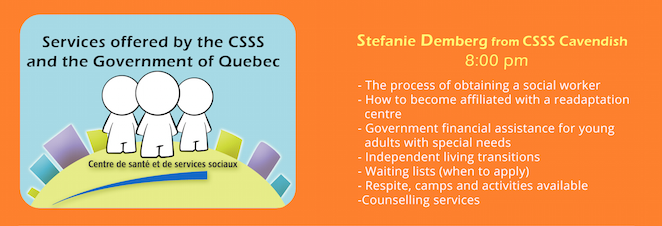
Stefanie Demberg from CSSS Cavendish will speak at 8 p.m. about the services offered by the CSSS and the government of Quebec.

The Fair and lectures all take place at the EMSB, 6000 Fielding Avenue, Montreal, Quebec.

Space is limited, so register today at transitionfairinfo@gmail.com or call 514-484-4161.

We look forward to seeing you there, so stop by the Inspirations table - we have a special surprise for our first few visitors!

www.inspirationsnews.com
info@inspirationsnews.com

Tuesday, February 4, 2014

The Dynamic Funds Teacher of Inspiration 2013: Kaylie Bernert inspires at a country school with a big heart

The Dynamic Funds Teacher of Inspiration 2013: 
Kaylie Bernert inspires at a country school with a big heart


By Wendy Singer

Kaylie Bernert grew up on a farm in Franklin, Quebec. She earned her Bachelor of Education at Bishops University in 2009, and completed her final stage at Ormstown Elementary School (OES) of the New Frontiers School Board (NFSB) where she continues to teach today.

When she graduated, Bernert intended to use a constructivist teaching method. It took one day in the classroom to realize that she would need to be flexible and start by addressing the needs of her students including those with ADHD, severe physical disability, and soon-to-be-diagnosed autism.

Bernert leaned on her colleagues for guidance. “As new teachers, sometimes we feel the need to keep our classroom door closed and just try to survive, but our colleagues are such an asset. There are so many people that I clung to and asked to teach me everything they know. I would not be succeeding without the team at OES and NFSB,” shares Bernert.

Our Dynamic Funds Teacher of Inspiration 2013 handles the grade one year with great care: “We take our concerns seriously, we speak to our school board, specialists, and have the children seen. It’s challenging to have the responsibility of cycle one on your shoulders. We have such an impact on their lives.”

In her first year teaching, Bernert was concerned about one struggling student. “I felt like I was failing him. Everyone works at their own level, but something wasn’t working for him,” she explained.

The turning point was a diagnosis of autism. To decrease her student’s anxiety and sleepless nights, Bernert implemented a structured routine and visual scheduling, making things as consistent as possible between the home and school.

It turns out that scheduling proved to be beneficial all around. The anxiety level of the student with autism decreased, allowing him the opportunity to learn, the entire class became more focused and grounded, and once accustomed to scheduling, it made Bernert’s preparation and teaching days flow more easily.

David Brisebois, principal of OES (fondly referred to as ‘Mr. B’) commends Bernert for creating a dynamic partnership with this student and his parents and fostering a home program that closely resembles what is happening at school.

This compassionate teacher weaves two important life lessons into her teaching year-round:

1. We are all different, and therefore learn differently. For example, the student with ADHD learns better when his body is moving.

2. Fair means you get what you need, and that might not be the same for everyone. A student with ADHD might be entitled to a fidget toy, a lap lizard, or permission to get a ‘passport’ stamped at the office if the student needs to move.

Mr. B considers himself lucky to have this devoted and passionate teacher on his team. “Kaylie is only in her fourth year of teaching but shows wisdom, confidence and poise beyond these few years. In her room, education is magical. Learning is fun.”

Thrilled to work at this 123-student country school, Bernert’s love of teaching and her students is undeniable. She treasures each ‘ahah’ moment, and beams while sharing the news that her student with autism is thriving, recently achieving 100% on a math exam.

Bernert is influenced daily by the wisdom of her mentor Carole Creswell and internship supervisor Joy Palmer. Bernert often returns to advice that Creswell shared with her early on in her teaching career: ‘Some days your job is just to care for the students, listen to them, and send them home knowing they felt loved.’ “That,” reflects Bernert, “Is what it’s all about.” 

Dynamic Funds was established as a small investment club in Montreal in 1957, where it was a pioneer in providing professional investment advice to retail investors. Since then, Dynamic has evolved to become one of Canada’s most recognized wealth management firms. They offer a comprehensive range of products and services, spanning every major sector, geographic region and investment discipline. Dynamic’s financial solutions include open and closed-end in- vestment funds, fee-based, tax-advantaged and customized high-net-worth programs.